


Louisville Merger Heats Up
 Wednesday, July 27, 2011 at 11:25AM
 In just a few weeks, people in Louisville, KY have truly impressed us with their response to a large hospital merger proposal. The plan would require a public teaching hospital, which is the area’s safety net for low-income patients, to adhere to religious rules that restrict basic health care. As one editorial from the Courier Journal asked:
“How can the state or the city allow this to happen, and to permit millions of dollars of the public's money to be allocated and spent in shadowy backrooms, where Catholic bishops will have more influence than doctors or the people of this city?”
In June of this year, three health systems in the metro area of Louisville announced their plans to merge into a state-wide network:
- Jewish Hospital & St. Mary's HealthCare/Jewish Hospital HealthCare Services (JHSMH);
- Catholic Health Initiatives (CHI) and its Kentucky-based operation, Saint Joseph Health System; and
- the University of Louisville Hospital/James Graham Brown Cancer Center (U of L), a traditionally secular hospital which receives about $68 million in state and local funds to provide indigent care in Louisville.
The deal would give Denver-based CHI, which currently has a 25% share in a joint venture with the Jewish Hospital system, the dominant presence in the Louisville region. It has been reported that CHI would inject over $300 million of operating capital into the new system and thus acquire a majority equity stake in the overall company.
Reproductive health threatened
The unfortunate result of this transaction would be that all the merged assets of the new entity -- including traditionally non-Catholic facilities at Jewish and U of L --would follow the Ethical and Religious Directives of Catholic Healthcare Services (ERDs). These Catholic restrictions prohibit the delivery of key reproductive health services, such as tubal ligation at the time of cesarean delivery or provision of emergency contraception in the emergency department.
The merger partners promised that University Hospital would continue to provide a full range of reproductive services (Jewish no longer has an obstetrical unit). But they have presented no plan as to how this would be accomplished, since the hospital would be subject to Catholic health restrictions. The Louisville Board of Health, a mayor-appointed body whose mission is to promote and protect equitable health in the community through advocacy and education, did their homework and published an excellent op-ed in the local paper shortly after the merger announcement:
"Some communities around the country have faced challenges in health care delivery in the aftermath of similar mergers, including loss of key reproductive health services such as contraception (including in cases of sexual assault), tubal ligations, and vasectomies. Here in Louisville, merger representatives have assured us that measures will be taken to address these challenges. However, because it is those with fewest health care access options who stand to lose the most if access to such services were limited by the merger, it is important that we ask these questions now so that the community is aware and has the opportunity to engage in a community dialogue."
A few letters to the editor came in supporting this polite inquiry into how the merger partners planned to protect healthcare from religious restrictions, especially for those who depend on the hospital as a safety net provider.
Community opposition builds
And then Louisville residents woke up Sunday morning a few weeks ago and read this headline:“Hospital merger limits medical options: Catholic rules will bar tubal ligations at University hospital. In the featured article, U of L officials attempted to share more details about how they planned to preserve services. In this case they were considering the option of moving family planning and elective sterilization to a separately-incorporated surgery center across the street from University Hospital. However, this setting cannot offer tubal ligations at the time of a cesarean. When asked how the hospital planned to resolve this gap, the public was essentially told, “We don’t have a plan yet but we’re working on it. Trust us.”
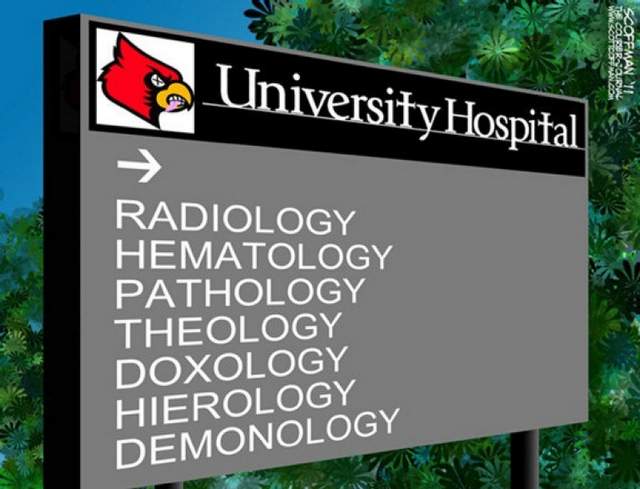 "Hospital Wings" Editorial Cartoon from The Couier-JournalLetters to the editor started pouring in to the Courier Journal. The paper’s editorial board called the merger proposal “disturbing.” A petition began to circulate and by the weekend it was published with over 500 signatures opposing women’s health being bartered away. Some of those signers included city council members and Kentucky lawmakers. In the same issue, a joint letter from the three merger partners was published offering promises, but again remaining vague about the details. By mid-week, U of L tried to stem the tide of opposition by holding a press conference. But promises without a clear-cut plan only exacerbated the situation.
That same day, Kentucky Attorney General Jack Conway announced that he plans to review the merger to make sure consumers and taxpayers’ interests are protected. MergerWatch’s Director was interviewed for a radio segment on the “hospital within a hospital” solution. Similar to the idea of putting restricted services in a separately-incorporated adjacent building, this type of “carve-out” facility would actually be inside the hospital itself thereby allowing tubal ligations at the time of cesarean to take place. This creative, but complex, solution has been successfully implemented in other merger cases in Texas, Wisconsin and New York.
The next morning, Mayor Greg Fischer met with the President of the University of Louisville seeking specific plans for protecting health care that would be banned under Catholic rules. He was assured that the public’s concerns would be resolved, adding “I have no reason to believe they’re telling me something that is not true.” We do.
On Sunday July 24th, the Courier Journal examined how end-of-life decision-making could change at University Hospital if the ERDs were put into place there. More scathing editorials and letters to the editor were published this week and we were again impressed with the depth of inquiry and the pressure the public continues to put on the merger partners.
On July 26, Kentucky lawmakers called on President Ramsey to defend the hospital merger before a legislative committee and explain how reproductive health and end of life care will be protected. Ramsey has not confirmed that he will attend the August 17th meeting of the Interim Joint Committee on Health and Welfare.
Today, the outcry continues with new questions being rightfully asked: this time on whether pregnancy emergencies will be treated using the standards of care at University Hospital once they are subject to Catholic rules. We will continue to follow this case as these tough questions get asked and public pressure mounts around the future of health care in the metro area of Louisville.
MW Editor
This just in: State AG says the merger will require state approval